Pozn.: F. K. Zeman přepracoval tuto hru jako „valašskou idylu“ do tvaru povídky, která vyšla v časopise Týden rozhlasu (prosinec 1939) a později jako novoročenka F. K. Zemana (PF 1940).
Lit.: Zeman, F. K.: Pásli ovce valaši. PF 1940. Vydal F. K. Zeman, vytiskla knihtiskárna Orbis (Praha XII, Fochova třída 62). v edici Vánoční pozdravy řada I. (16 s., ilustrace Antonín Strnadel).
Kdy proběhlo první cirkusové představení v Česku a co vlastně definuje estetiku tohoto tzv. kulatého umění? Daniela Vrbová vás provede dějinami tradičního cirkusu od kočovných rodinných podniků po státní Československé cirkusy, varieté a lunaparky po roce 1948. A jak se proměnili cirkusáci a jejich diváci po roce 1989? Bude se také věnovat tzv. novému cirkusu. Tedy spojení artistiky a klaunerie s divadelním příběhem – tak, jak je známe například z Osvobozeného divadla Voskovce a Wericha nebo Manéže Bolka Polívky.
Bohumil Lipert. Rozhlasová dramatizace detektivní povídky. Připravila Evqa Lenartová. Technická spolupráce Marek Hoblík. Režie Peter Gábor.
Osoby a obsazení: Marek Svoboda (David Viktora), Šedivá (Tereza Richtrová), sekretářka Vránová (Renáta Klemensová), Eva, Markova žena (Pavlína Kafková), vypravěč (Tomáš Jirman), David Depta, Jan Lefner a Marian Mazur.
Připravil ČRo Ostrava v roce 2014. Premiéra 10. 1. 2015 (ČRo 2 Praha, 22:00 h.; 29 min).
Lit.: anonym: Bohumil Lipert: Ze života pořádkumilovného muže. In web ČRo 2 Praha, leden 2015 (článek). – Cit.: Proč se začne hroutit svět plný čísel ekonoma Marka Svobody? Může za to žena. Jak taky jinak. Hrdina povídky je člověk, který myslí v číslech a účetních kolonkách. Když však do firmy, ve které pracuje, nastoupí mladá, krásná a ambiciózní kolegyně, je náhle všechno jinak a vypočitatelný svět Marka Svobody se hroutí. Je to, zdá se, rovnice, která nemá řešení.
Povídku zařadila v roce 1999 Česká asociace autorů detektivní a dobrodružné literatury do sborníku Nejlepší detektivní povídky desetiletí, ostatně Bohumil Lipert byl zkušeným autorem kriminálních příběhů a soudniček.
Tristan Tzara. Jazz doprovází poezii, poezie doprovází jazz. Verše z knihy „Slunná silnice samá radost“ přeložili Adolf Kroupa a Ivo Fleischmann. Použitá hudba John McLaughlin, Elvin Jones a Joey DeFrancesco. Hudební dramaturgie Daniel Dobiáš a Vladimír Truc. Režie Markéta Jahodová.
Recituje Pavel Soukup.
Natočeno 2014 (?). Premiéra (?) 10. 1. 2015 (ČRo 3 Vltava, 17:45 h.; 30 min) v cyklu Jazzový podvečer. Repríza 5. 1. 2019 (ČRo 3 Vltava, 18:00 h) v cyklu Jazzový podvečer.
Lit.: Novotná, Klára: Výročí týdne – Josef Kemr (20. 6. 1922-15. 1. 1995). In Týdeník Rozhlas 2/2015, s. 23 (článek). – Cit.: „Hele, hele, najdi si jakékoliv zaměstnání, ale do nejistoty ke komediantům tě nepustím!“ oznámil rezolutně otec dospívajícímu Josefu Kemrovi, který po prvních zkušenostech ve Vinohradském divadle a ve filmech Lízin let do nebe a Lízino štěstí propadl kouzlu herecké profese. Na otcův zákaz reagoval tehdy Josef útěkem z domova k herecké společnosti Anny Budínské-Červíčkové, kam jej přivedl celoživotní přítel a kolega Rudolf Hrušínský. Setrval tu do konce protektorátu a roky každodenního, někdy až úmorného účinkování se pro něj staly nejlepší dramatickou školou.
Po válce vystřídal Josef Kemr několik angažmá: mimo jiné v kladenském divadle, v Divadle S. K. Neumanna a konečně od roku 1950 v nově ustavených Městských divadlech pražských. Do paměti diváků se tu zapsal jako Zevakin v Gogolově Ženitbě, Jonáš v Nashově Obchodníku s deštěm nebo v titulní roli bajkáře Ezopa v Lišce a hroznech Giulherma Figueireda. Roku 1965 vstoupil do Národního divadla a na jeho prknech odehrál za třicet let více než osmdesát rolí. Ještě jako host tu nastudoval roli chameleonsky proměnlivého vesnického holiče Smrtáka v Topolově básnickém dramatu Konec masopustu. Následovala dlouhá řada postav, které obdařil celou šíří svého talentu i řemeslné virtuozity – muzikálností, tvárností v gestu i mimice, přesně mířenou energií i smyslem pro humor. Nastudoval úlohy veskrze komediální (Pandolfo v Zeyerově Staré historii nebo Kavalír v Goldoniho Náměstíčku), vdechnul přirozenost a prostotu lidovým figurám (Habršperk z Našich furiantů či vychytralý Krištof z Roku na vsi) a se vší citlivostí a hloubkou prožitku nechával ožít postavy tragické – k jeho vrcholným výkonům patřil Doktor Galén v Macháčkově inscenaci Čapkovy Bílé nemoci. Svou pracovitost, hereckou vnímavost, ale i výraznou tvář a ojedinělý hlasový projev uplatnil výborně také ve filmu, kde ztvárnil na dvě stě padesát rolí.
Nad múzičností, všestranným talentem i absolutní profesionalitou Josefa Kemra se však klene ještě další rozměr. Byl hluboce věřícím člověkem – pokora před Bohem a laskavost k bližním provázely každou práci, kterou se zabýval, a dávaly jí jasný, nezkalený smysl.
Lit.: Kroupa, Daniel: Fobie. In web ČRo Plus, leden 2015 (text glosy + nahrávka k poslechu). – Cit.: Díky tomu, že my lidé jsme tělesnými bytostmi, máme každý na světě své místo a z tohoto místa vidíme věci jinak, než jak je vidí ostatní, kteří stojí jinde.
Protože máme řeč a můžeme si sdělit, co kdo vidíme, máme úžasnou příležitost porovnávat, a tak dospívat k lepšímu poznání o světě kolem nás. Říkáme tomu dialog, který po téměř dvou a půl tisíci letech můžeme považovat za osvědčený způsob společného poznání pravdy. Jedním z předpokladů jeho úspěšnosti ale je, že se musí partneři brát vážně. A o to právě jde.
V poslední době jsme často svědky, že když se vynoří nějaký společenský problém, ozývá se volání po veřejném dialogu. Hned je ale jedna strana dialogu diskvalifikována tvrzením, že je postižená fobií. Jedno jakou: islamofobií, xenofobií, homofobií, rusofobií a kdo ví jakou další. Vždyť na wikipedii jich naleznete několik desítek a pokud snad k danému tématu chybí, snadno je doplníte prostým připojením onoho řeckého slůvka. (more…)
Ronald Knox. Sensační rozhlasová hra z anglické vzpoury nezaměstnaných. Další tvůrci a interpreti nezjištěni.
Nastudoval BBC v roce 1926. Premiéra 16. 1. 1926 (BBC).
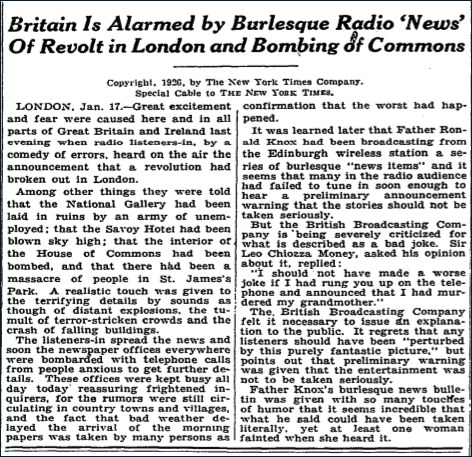
Lit.: Sýkora, Michal: Všichni znají případ paniky, které vyvolala Wellesova rozhlasová adaptace Války světů. Welles ovšem nebyl první… In Facebook, 29. 10. 2018 (status). – Cit.: 15. ledna 1926 připravil Ronald Knox (ano, ten Knox, který vytvořil slavných deset pravidel detektivky) pro BBC, která chtěla zvýšit atraktivitu vysílání, parodický pořad „Vysílání z barikád“. Šlo o živou „reportáž“ z demonstrace na Trafalgar Square, jež přerostla v divoké násilí, v rámci něhož demonstranti zničili hotel Savoy, zlynčovali ministra dopravy a nakonec i vítězně vzali útokem sídlo BBC. Jakkoliv šlo o dílo plné nadsázky (demonstraci pořádalo Národní hnutí za zrušení front v divadlech), posluchači celou „reportáž“ vzali vážně, čemuž přispěl i fakt, že ten den postihla Londýn sněhová kalamita, kvůli které nebyly distribuovány tištěné noviny.
Program trval 20 minut a Knox vůbec neměl potuchy, co způsobil. Vyděšení posluchači telefonovali do Admirality a dožadovali se nasazení královského námořnictva na Temži. Skandál dosáhl až do nejvyšších kruhů. Lord Mayor of Newcastle si například stěžoval, že kvůli pořadu byla jeho choť „vážně rozrušená“. Knox se pak na nějakou dobu dostal v BBC na černou listinu, protože vedení se bálo, aby zas něco neprovedl. Šíření fake news, model 1926.
Lit.: anonym: Ronald Knox – Radio hoax. In web Wikipedia, b. d. (článek). – Cit.: In January 1926, for one of his regular BBC Radio programmes, Knox broadcast a simulated live report of revolution sweeping across London entitled Broadcasting from the Barricades. In addition to live reports of several people, including a government minister, being lynched, his broadcast mixed supposed band music from the Savoy Hotel with the hotel’s purported destruction by trench mortars. The Houses of Parliament and the clock tower were also said to have been flattened.
Because the broadcast occurred on a snowy weekend, much of the United Kingdom was unable to get the newspapers until days later. The lack of newspapers caused a minor panic, as it was believed that this was caused by the events in London.
A 2005 BBC report on the broadcast suggests that the innovative style of Knox’s programme may have influenced Orson Welles’s radio broadcast „The War of the Worlds“ (1938), which foreshadowed it in its consequences. In an interview for the book This is Orson Welles, Welles himself said that the broadcast gave him the idea for „The War of the Worlds“.
The script of the broadcast is reprinted in Essays in Satire (1928).
Lit.: anonym: „England fooled by radio burlesque.“ In The Sioux City Sunday Journal, 25. 4. 1926.
Lit.: anonym: Broadcasting the Barricades by Ronald Knox (BBC, 1926) part 1. In web Archive.org, b. d. (článek). – Cit.: It is often said there is nothing new under the sun, but occasionally someone comes along who appears to contradict the apparent infallibility of the phrase. Orson Welles is often and deservedly spoken of in terms of his brilliance and originality, and without doubt one of his crowning achievements was his 1938 radio broadcast of The War of the Worlds, yet even this amazingly original sounding production can be found to have an extraordinary (though little known) precursor. It may even have influenced Welles and his writing team, though that is a lot harder to prove.
It all happened in England, some 12 years before Welles and his Mercury Theatre On The Air stunned America with their Martian invasion. Rather oddly, this early example of a panic broadcast was instigated by an unconventional priest named Father Ronald Knox, who rather like Welles, was a multi-disciplined character. He was an accomplished translator, an extremely well known and respected commentator for the Catholic Church, and a successful crime fiction writer! He was also something of a practical joker.
In 1926, he was working for the fledgling British Broadcasting Company, which was then only some 4 years old. On January 16th, at 7.40pm in the evening (from cramped Edinburgh offices, located in the back premises of a music shop at 79 George Street) Knox began his one man reading of a production he called Broadcasting the Barricades. Constructed in an incredibly similar way to the Orson Welles War of the Worlds play, it begins in innocuous terms with a report on the latest Cricket scores, segues into a banal news story, and then suddenly takes a serious turn, reporting on a growing crowd of unruly demonstrators in Trafalgar Square. The demonstrators, described as an anti unemployment gathering, were reported to be led (in one of many blatant give-aways to the phoney nature of the broadcast) by a Mr Poppleberry, the secretary for the National Movement For The Abolishment of theatre Queues. Exactly like Welles‘ later broadcast, Knox next shifts to a musical number, leaving the audience with a sense of unease, but the impression that normal life goes on. There follows a weather forecast, more on the Cricket scores, then back to the demonstration, which is now pouring through Admiralty Arch in „a threatening manner.“
Again and again, Knox deftly switches between outrageous humour and drama, describing the crowd attacking water-foul on a lake with bottles and then „roasting alive“ a waylaid dignitary who was on his way to the radio studio. As Knox observes in brilliant deadpan style, „he will therefore be unable to deliver his lecture to you.“ More run of the mill interludes follow, then the announcement that the crowd are preparing to demolish the Houses Of Parliament with Trench Mortars. Knox follows with a description of the Big Ben clock tower crashing to the ground, a hugely iconic image that has since been repeated time and time again in modern films. Hilariously pricking the grandiosity of the moment, Knox says of this disaster, „Greenwich Time will not be given this evening by Big Ben, but will be given from Edinburgh on uncle Leslies repeating watch.“ As the broadcast nears its end, the Minister Of Traffic is hung from a lamppost in the Vauxhall Bridge Road, before the demonstrators enter the BBC broadcasting building and Knox draws proceedings to a close after just over eleven minutes of simulated mayhem.
The Knox broadcast certainly can’t boast the terrifying verisimilitude of The War of the Worlds, peppered as it is with his mischievous observations on the unlikely progress of the rioters. Unquestionably it is a very clever and amusing piece of work, but listened too today (the original broadcast is lost, but you can hear a reconstruction on the BBC website) there is nothing about it that can described as particularly disturbing or frightening, yet according to reports at the time, women fainted, Mayors dusted off emergency plans and one listener even called the Admiralty and demanded that the Navy be despatched up the Thames to deal with the rioters.
About 20 minutes after the broadcast finished and as he was sitting down to dinner (oblivious to the panic he had caused) Knox was interrupted by John Reith, the BBC General Manager with the news that calls were flooding in from concerned listeners. Knox’s sound man J C S Mcgregor took many of these calls, as he later recalled in the BBC staff magazine. „The debris of the Savoy hotel was still lying about the studio when the telephone bell rang. Was it true asked an agitated voice, that revolution had broken out in London? The next caller was more difficult. His wife had a weak heart and had fainted at the knees, and when he gathered from me that the whole thing was fictitious he exploded. What, he asked with some vigor did the BBC mean by it? Did we realise that we had grossly misled the country and were playing into the hands of the Bolsheviks?“
Lit.: anonym: Broadcasting the Barricades by Ronald Knox (BBC, 1926) part 2. In web Archive.org, b. d. (článek). – Cit.: Like the Orson Welles broadcast of 1938, some intriguing questions are raised by the Knox panic: how many people heard the broadcast, and how many were genuinely disturbed? To answer the first question, it has been suggested that up to 10 million people may have heard Knox that night. As an indicator, in 1926 the number of radio receiving licences had reached some two and quarter million. Given that large families would have listened together, the estimate of 10 million seems a quite reasonable one, especially as the British Broadcasting Company was the only broadcaster at the time.
So what was the extent of the panic? Like the Orson Welles broadcast, it is very difficult to gauge exactly how many people were fooled. I strongly suspect that in exactly the same manner as happened in America, some people would have tuned in late, catching the more alarming snippets of the production out of context, such as the explosion of the Savoy Hotel (created by smashing an orange box next to the microphone) or the hanging of the government minister. Where events differ to the Orson Welles broadcast is the lasting duration of the delusion. Heavy snow had fallen that night in London, and as a result, many papers (the only other form of news available) were delayed, adding to the sense of worry, though you can’t help but wonder why people did not just carry on listening to the radio?
It is particularly intriguing to hear how many of those pushed to the edge of hysteria seemed to have been members of the higher classes of society. There were reports of dinner parties erupting into panic, the Sheriff of Newcastle wondering how to provide defences to his city and the wife of a Mayor unsure how to inform her husband that the established social order was collapsing. I have returned many times in this article to the abundant parallels with the Orson Welles broadcast of The War of the Worlds, and here we find another. Welles tapped into the fears of the average American that their country might become involved in a new World War; in fact some who believed the Welles broadcast to be fact, assumed that the so called „news“ reports they were hearing had mistaken German troops for Martians. Britain in 1926 had its own problems to worry about. In late 1925, the government had arrested members of the Communist party (formed only 5 years previously) on charges of committing „seditious conspiracy.“ Five were sentenced to one year in prison. By the time of Knox’s broadcast, the spectre of a general strike (which eventually began on May 3rd that same year) was of considerable concern to the ruling classes of the country, with memories of the Russian revolution of 1917 still very raw. There was every concern the same thing might happen in Britain, so one can only imagine how radio listeners reacted to the Knox broadcast and the apparent destruction of the very centres of authority.
Like Welles in 1938, Knox was left surprised at the reception afforded to what he himself described as a burlesque. In yet another parallel to the events of 12 years later, the English papers enjoyed a chance to lambaste the radio, which just as in America, was perceived as a threat to their monopoly on news and entertainment. The newspaper industry had even refused to carry listings of radio programmes in case their sales were impacted. Unlike the reaction in America however, the general public seemed less concerned at the furore whipped up by the press. In his regular report to the governors of the BBC, John Reith commented that 2307 positive comments were received against only 247 negative. The BBC even gleefully considered pulling the prank again for the next April Fools Day.
The intriguing question arises, was Welles in any way inspired by Knox? It has been suggested that there is a clue in the Welles press conference the day after his broadcast in which he protested that his technique had not been a new one, but while it is perfectly true that he said this, it was far more likely that he was referring to Archibald MacLeish’s Air Raid. There is one reference in the BBC Radio Times of June 29th 1967 that claims a connection, but alas it does not stand up to analysis. Prompted by the BBC broadcast of a dramatisation of The War of the Worlds, a BBC correspondent in America called Leonard Miall suggests that John Houseman had heard the Knox broadcast while as a schoolboy living in England. It’s a lovely thought, but unfortunately the dates simply do not fit. Houseman did indeed live in England for a time, attending Clifton College in Bristol, but this was between 1911 and 1918. More damningly still, Houseman sailed for American in 1925, arriving in New York aboard the liner Mauretania on October 3rd. While it is conceivable that Houseman may have read the New York Times story of January 26th 1926 or friends back in England had corresponded with him and told him of the Knox broadcast, it seems difficult to believe that a decade later he would recall this relatively obscure event and be inspired to emulate it.
Lit.: Novotná, Iveta: Hra na skutečnost? Audiohry s dramaticko-publicistickou strukturou. Brno: JAMU, 2023 (disertační práce).
Lit.: anonym: A Priest and a panic. In web BBC Radio 4, 16. 7. 2005 (článek). – Cit.: In January 1926, 12 years before Orson Welles’s infamous War of the Worlds broadcast, the BBC sparked a national panic of its own…
It broadcast a 12 minute report of a murderous riot in central London, which turned out to be a spoof, masterminded by a literary Catholic priest.
This feature tells the so far untold story of the broadcast, puts it in historical context and explains its significance in the history of broadcasting.
Significantly Lord Reith cared more about reaction from listeners than what the press or Government thought. This at a time when the BBC’s independence was uncertain, and the BBC was seen by press as a threat.
The Story
On January 16, 1926, one Father Ronald Knox, a catholic priest, interrupted an apparently genuine BBC talk on 18th century literature with a report that Big Ben had been toppled by trench mortars, the Savoy Hotel torched, and a Government minister lynched.
The Russian revolution was then less than a decade old, the General Strike already in preparation.
In this febrile atmosphere, many took Knox’s satire seriously, besieging the BBC with worried phone calls. Bad weather delayed delivery of the next day’s papers, giving rural listeners prolonged reason to assume the capital was in flames.
The BBC made several announcements later that evening that the progamme had been ‚a burlesque‘ but these assurances went largely unheard. (…)
Lit.: Krupka, Jaroslav: Hřích pátera Knoxe: Slavný kaplan vyděsil před 100 lety Anglii satirou v rádiu. In Deník.cz, 16. 1. 2026 (článek). – Cit.: Rozhlasové vysílání o údajné dělnické revoluci vyvolalo 16. ledna 1926 paniku po celé Anglii. Tehdy šlo vlastně o zbytečný poplach, ale v květnu téhož roku opravdu zachvátila Londýn stávka, při níž dav převracel a zapaloval auta a zasahovala i armáda.
Historie o tom, jak rozhlasová adaptace románu Válka světů o invazi mimozemšťanů od Orsona Wellese vyvolala v roce 1938 paniku ve Spojených státech amerických, je docela známá. Méně se ví, že s tou panikou to vlastně nebylo tak horké. A ještě méně, že nešlo o Wellesův původní nápad, protože podobná situace se už odehrála dříve, 16. ledna 1926 v Anglii. Zemi tehdy vyděsil údajný rozhlasový přenos z dělnické vzpoury v Londýně. Šlo o žert legendárního pátera Ronalda Knoxe.
V první polovině 90. let minulého století byl na obrazovkách České televize hodně populární televizní seriál Hříchy pro pátera Knoxe, natočený podle stejnojmenné knižní předlohy spisovatele Josefa Škvoreckého a vysílaný v přímém přenosu.
Onen páter Knox, který definoval desatero přikázání pro autory detektivních příběhů (viz box na konci článku), z nichž každý díl seriálu jedno porušil, skutečně existoval – jeho křestní jméno znělo Ronald, byl to skutečně katolický kněz, a navíc se věnoval literární tvorbě. Do dějin světové kultury se však zapsal i lecčím dalším, než jen stanovením zákonitostí správné dektektivky. Například to byl právě on, a nikoli až Orson Welles, kdo svou rozhlasovou mystifikací vyvolal nakrátko skutečnou paniku v celé zemi, protože ji někteří posluchači zaměnili za skutečnost. Stalo se to právě před sto lety, v sobotu 16. ledna 1926.
BBC: Na Londýn útočí nezaměstnaní
V té době svíraly Británii ještě tužší mrazy, než jaké o sto let později zažívá Česká republika. „Byla to krutá zima: řeky byly zamrzlé, vlakové tratě nesjízdné, noviny se nedaly doručovat. Posluchače BBC však onen sobotní večer čekal ještě větší šok,“ píše Matthew Lyons na stránkách History Today.
V čem onen traumatický zážitek spočíval? Po přednášce o literatuře 18. století následovalo zpravodajství. A posluchači v něm najednou uslyšeli, že Londýn obléhají nezaměstnaní.
„Právě drancují Národní galerii,“ oznámil hlasatel – a přepnul na počasí. O chvíli později přišla aktualizace. „Sir Theophilus Gooch, známý svými četnými filantropickými projekty, k vám nyní promluví na téma bydlení pro chudé,“ prohlásil hlasatel, jímž nebyl nikdo jiný než sám Knox. Filantropův projev ale v rádiu nikdy nezazněl, protože se místo něj ozvalo další děsivě znějící hlasatelovo oznámení: „Ze zpráv, které jsme právě dostali k dispozici, se zdá, že sira Theophila Gooche, jenž byl na cestě sem do rádia, zastavily zbytky davu stále shromážděné na Trafalgarském náměstí a že ho upekli zaživa,“ cituje Knoxovu hříčku Karl Keating na stránkách Catholic Answers.
A katastrofické zprávy se z rozhlasového vysílání linuly pořád dál. Taneční hudbu z hotelu Savoy prý přerušil útok minometů na Big Ben. Ministr dopravy Wurtherspoon, jenž se pokoušel utéct v přestrojení, byl odhalen ve Vauxhallu a oběšen na pouliční lampě. Zprávy doprovázely zvuky davu v pozadí a výbuchy v dálce. Jako poslední byla odvysílána informace, že dav postupuje k budově rozhlasu. Pak reportáž utichla.
Panika v zemi
Vysílání vyvolalo v zemi dočasně opravdové zděšení, alespoň u té části britské populace, která zapnula své rozhlasové přijímače trochu později, a tak neslyšela úvodní hlášení, že bude odvysílán skeč Ronalda Knoxe, katolického kněze a občasného humoristy.
Tito posluchači si tak nevšimli ani několika vtipných narážek v pořadu, jež měly naznačit, že jde o humor: třeba že jedním z iniciátorů nepokojů je pan Popplebury – tajemník Národního hnutí za zrušení divadelních front nebo že slavný londýnský Big Ben se sice zřítil k zemi, ale Londýňané že o tradiční odbíjení hodin nepřijdou, protože si je poslechnou z hodinek strýčka Leslieho v Edinburghu (v Edinburghu se nacházelo studio BBC, odkud Knox vysílal).
Generální stávka v Anglii v roce 1926. Nákladní auto naložené kanystry s benzínem doprovázejí a střeží policisté na koních. Vůz je na cestě do skladu v rovněž hlídaných parcích. Lidé stojí u silnice a přihlížejí. Londýn, 1926
Po skončení pořadu tak skutečně zavládla panika, která přetrvala až do dalšího dne: „Někteří londýnští posluchači vyběhli do ulic ve snaze uprchnout z města, zatímco ti mimo město telefonovali úřadům a novinám, aby zjistili, co se děje. Zmatení úředníci se sice zapřísahávali, že je všechno v pořádku, ale volající tím moc neukldinili, protože ti byli přesvědčeni, že se něco dít musí, když to přece slyšeli v rádiu,“ uvádějí stránky Hoaxes.
Telefonní ústředna v hotelu Savoy později oznámila, že obdržela přes 200 dotazů, zda je hotel v troskách, nebo zda jej lze stále navštívit, a pokud ano, jestli je ta návštěva bezpečná. Některé z těchto telefonátů a telegramů přišly až z Manchesteru a Newcastleu. V několika malých městech policie druhý den ráno hlásila, že stále přijímá úzkostné hovory ohledně osudu Londýna. Když mlékaři začali ráno rozvážet konve s mlékem, chtěli od nich informace jejich zákazníci.
Toto všeobecné znepokojení přiživil ještě fakt, že spousta lidí nedostala kvůli mrazu své noviny, takže zaslechnuté rozhlasové vysílání pro ně představovalo jediný informační zdroj. „Špatné počasí zpozdilo následující den doručení novin, takže posluchači na venkově se mohli dlouhodobě domnívat, že Londýn hoří. Přestože stanice později večer několikrát oznámila, že pořad byl jen nadsázka, tato ujištění zůstala do značné míry nevyslyšena,“ uvedla před 20 lety BBC.
Společenská situace fámě nahrávala
Na obranu znepokojených posluchačů je třeba uvést, že slova o zuřivém dělnickém převratu nezněla v roce 1926 nijak nevěrohodně. Svět měl v té době v živé paměti devět let starou bolševickou revoluci v Rusku, vedoucí ke vzniku prvního bolševického státu, své pokusy o násilné převraty za sebou mělo Německo, Maďarsko, v lehké formě i Československo, Itálie zažila Mussoliniho převrat, po němž se změnila ve fašistický stát, a strašidlo fašistické nebo komunistické diktatury obcházelo i další země.
Navíc sociální situace v Británii nebyla v roce 1926 skutečně nijak jednoduchá. Důkazem neutěšeného stavu byl fakt, že v květnu toho roku zasáhla zemi generální stávka, první a jediná, která se kdy v Británii konala. Byla vyhlášena 3. května a trvala devět dnů. „Šlo o historickou stávku britských dělníků, která vyjadřovala nespokojenost milionů lidí a ohlašovala potřebu změn v celé zemi,“ píše o ní britský web Historic UK.
Stávku vyhlásil britský Odborový kongres v reakci na špatné pracovní podmínky a snižování mezd. Vyvolaly ji problémy v těžebním průmyslu, který čelil vyčerpání zásob uhlí a masové nezaměstnanosti, k horníkům se ale přidaly i další dělnické profese a nakonec v květnu stávkovalo přes milion Britů.
Nespokojenost dělnických mas se už od začátku roku nepříznivě podepisovala na společenské atmosféře v zemi, která byla napjatá a plná nervózního očekávání. Není divu, že v takovém celkovém rozpoložení dokázalo hodně lidí uvěřit zprávě, že v Londýně došlo k násilnému dělnickému převratu a město hoří.
Ze skandálu těžil tisk
Nedomyšlená rozhlasová hříčka pověst rádia těžce poškodila, což ještě přiživil tisk, který z ní těžil a do rozhlasové stanice se po několik dní tvrdě navážel. „Teror způsobený ve vesnicích a městech. Chyba BBC,“ burácel například dobový titulek v Daily Express.
Důvodem, proč si tiskové redakce na maléru rozhlasového vysílání tak smlsly, ale nebylo ani tak mravní pobouření, jako spíše snaha poškodit nevítaného konkurenta. Jak už bylo zmíněno, druhá polovina 20. let minulého století nebyla pro Británii po hospodářské stránce tím právě nejjednodušším obdobím, nejedny noviny bojovaly na trhu o přežití a rádio pro ně představovalo nevítaného konkurtenta, který jim značně odčerpával příjmy z reklamy. Knoxova satira, kterou lidé vzali vážně, teď dala tisku příležitost zdiskreditovat rozhlas jako nedůvěryhodný a nezodpovědný zdroj zpráv, a tím posílit svou vlastní pozici.
Úplně stejný postoj tisku mimochodem o 12 let později nechvalně proslavil rozhlasovou adaptaci Wellesovy Války světů. „Tehdejší údajná panika byla ve skutečnosti kvůli nočnímu vysílání tak nepatrná, že se nedala prakticky změřit. Navzdory opakovaným tvrzením o opaku se Wellesovým vysíláním téměř nikdo nenechal oklamat,“ uvedli v roce 2013 Jefferson Pooley a Michael J. Socolow v článku Mýtus o panice kvůli Válce světů. Možná je namístě otázka, zda tomu nebylo podobně i v Anglii, neboť také o této události dnes víme zejména díky tehdejšímu novinovému zpravodajství.
BBC nakonec zklidnila situaci tím, že ve vysílání opakovaně uvedla, že všechny zaslechnuté zprávy o děsivých událostech byly součástí komické scénky otce Ronalda Knoxe s názvem „Vysílání z barikád“ a zpravodajství pouze napodobovaly. Stanice dále vydala následující oznámení: „Někteří posluchači, kteří v sobotu večer v 19:40 slyšeli pouze část proslovu reverenda Knoxe, si neuvědomili humorné narážky skryté v jeho imaginárních zprávách a mají obavy ohledně osudu Londýna, Big Benu a dalších míst a objektů zmíněných v proslovu. Ve skutečnosti se v předběžném oznámení uvádělo, že proslov je parodií na vysílání. Celý proslov byl samozřejmě burleskou. Doufáme, že všichni posluchači, kteří si to neuvědomili, přijmou naši upřímnou omluvu za případné způsobené nepříjemnosti. Londýn je v bezpečí. Big Ben stále zvoní a vše je v pořádku.“
Rozverný páter
Pokud jde o samotného pátera Knoxe, ten si zpočátku zděšenou reakci publika docela užíval. „Prohlásil, že ho téměř elektrizovalo, když se dozvěděl, že volali až z Dundee, aby zjistili, kolik toho v Londýně ještě stojí,“ píše Matthew Lyons (Dundee je skotské město ležící u ústí řeky Tay do Severního moře, které patří k nejsevernějším obydleným místům Británie).
V neděli už ale měl i rozverný páter povyku kolem svého vtípku dost a prohlásil, že ho to unavuje. V projevu, kterým vyjádřil své motivy a postoje, dále uvedl, že humor považuje za neocenitelného kamaráda v dlouhých bezesných nocích, zatímco satira je blahodárný jed.
Ronald Knox byl vůbec svérázný a renesanční člověk. Původně byl vysvěcen na kněze anglikánské (protestantské církve), později ale konvertoval ke katolicismu a od roku 1926 sloužil jako kaplan Oxfordské univerzity. Také byl ale spisovatelem, humoristou, rozhlasovým moderátorem a vědcem, přičemž uměl všechny tyto profese pozoruhodným způsobem kloubit dohromady. To ostatně prokázal svým slavným „Desaterem přikázání pátera Knoxe pro autory detektivních příběhů“, v němž se pokusil kodifikovat formu kriminální literatury, do níž se může zapojit sám čtenář tím, že se pokusí najít řešení záhady dříve, než je odhalí fiktivní detektiv.
Kromě tohoto desatera se nejvíce proslavil právě onou rozhlasovou mystifikací z roku 1926, v té době skutečně originální, jež měla inspirovat i samotného Orsona Wellese při tvorbě rozhlasové adaptace Války světů pro stanici CBS News. Welles to aspoň připouštěl v rozhovoru, který vyšel v biografii This is Orson Welles z roku 1992. Knox byl také autorem prvních falešně historických studií o údajném skutečném životě Sherlocka Holmese, doktora Watsona a dalších legendárních literárních hrdinů a prvních falešně vážných kritických pojednání o nich. Vtipný a trochu jedovatý kněz se dožil 69 let. Zemřel v roce 1957. (…)
Lit.: Lyons, Matthew: Ronald Knox’s Radio Revolution. In web History Today 1/2025 (článek). – Cit.: On 16 January 1926, the BBC broke the news that a murderous mob was storming the capital. Broadcasting the Barricades wasn’t supposed to be a hoax, but it was an effective one.
It was a bitter winter: rivers were frozen, trains derailed, newspapers undelivered. But listeners to the BBC on the evening of Saturday 16 January 1926 were in for a bigger shock.
A talk on 18th-century literature was followed by a news bulletin. London, listeners heard, was under siege from a mob of the unemployed. The National Gallery was being sacked, the announcer said – before switching to the weather. Moments later, an update. A philanthropist, due to give a BBC talk, was being roasted alive in Trafalgar Square.
Events snowballed. Dance music from the Savoy was interrupted by a trench-mortar attack on Big Ben. The minister for traffic was hanged from a tramway post. More music from the Savoy was cut short by an explosion. The mob was advancing on Broadcasting House. Then the report broke off.
The nation was stunned. At least the part of it that hadn’t heard the preliminary announcement of a skit by Ronald Knox, Catholic priest and sometime humorist. Had they not noticed that the mob’s fury was driven by Mr Popplebury, secretary of the National Movement for Abolishing Theatre Queues? Apparently not.
Newsrooms nationwide were flooded with calls. One London hotel alone received 200 telegrams asking if it was safe to visit. In the absence of newspapers, people pestered the police; in Dublin the following day milkmen shared the news on the doorstep.
The press had a field day. ‘Terror Caused in Village and Towns’, a Daily Express headline roared. ‘A Blunder by the BBC.’ The BBC released a transcript as clarification, complete with audio descriptions: ‘Wireless noises bizz, bang, bizz’, and so on.
As for Knox himself, he enjoyed the reaction at first, declaring himself ‘almost electrified to learn that Dundee had rung up to know how much of London was left’. But by the end of the week he pronounced himself tired of it. Humour, he said in a talk that Friday, was our ‘inestimable playmate … in the long watches of a hopeless night’, while satire was a beneficent poison. Whether he intended his hoax as play or poison he didn’t say. (…)
Lit.: Brain, Jessica: The General Strike 1926. In web Historic-UK, b. d. (článek). – Cit.: The General Strike, the only one to take place in Britain, was called on 3rd May 1926 and lasted nine days; an historic walkout by British workers representing the dissatisfaction of millions and ushering in the need for change across the country.
On 3rd May 1926, a General Strike was called by the Trade Union Congress in response to the poor working conditions and lessening of pay. This became one of the largest industrial disputes to take place in British history, with millions of people participating in the nine day strike, showing the togetherness and solidarity amongst workers.
There were several reasons contributing to the call for a General Strike. The problems began during the First World War when the high demand for coal lead to a depletion of reserves.
By the end of the war, falling exports and mass unemployment created difficulties throughout the mining industry. This was further impacted by the failure of mine owners to embrace the essential modernisation of the industry as other countries had done such as Poland and Germany. Other countries were mechanising pits in order to increase efficiency: Britain was falling behind.
Furthermore, as the mining industry was not nationalised and was in the hands of private owners, they were able to make decisions such as cutting pay and increasing hours with no repercussions. Miners were suffering: the work was difficult, injury and death was commonplace and the industry was failing to support its workers.
Another factor which worsened the fortunes of the British coal industry was the impact of the 1924 Dawes Plan. This was introduced in order to stabilise the German economy and relieve some of the burdens of wartime reparations, an effective bolster for the German economy which managed to stabilise its currency and re-align itself into the international coal market. Germany began providing “free coal” to French and Italian markets as part of their reparation plans. What this meant for Britain was falling coal prices, impacting negatively on the domestic market.
Whilst coal prices began to fall, they were further impacted by Churchill’s decision to reintroduce the gold standard in 1925. Despite the warnings from the famous economist, John Maynard Keynes, Churchill’s policy was put into practice, a decision that would be remembered as an “historic mistake” by many.
The Gold Standard Act of 1925 effectively had the ill-advised effect of making the British pound too strong against other currencies, adversely affecting the export market in Britain. The strength of the currency needed to be maintained through other processes, such as raising interest rates which in turn proved detrimental for business owners.
The mine owners therefore, feeling threatened by the economic decision-making around them and yet unwilling to concede a declining profit margin, made the decision to cut wages and increase working hours in order to maintain their business outlooks and profit potential.
The miners’ pay in a seven year period was reduced from £6.00 to a miserly £3.90, an unsustainable figure contributing to severe poverty for a generation of workers and their families. When the mine owners announced their intentions to reduce wages further, they were met with fury by the Miners Federation.
“Not a penny off the pay, not a minute on the day”.
This was the phrase which echoed around the mining community. The Trade Union Congress subsequently backed the miners in their plight, whilst in government Stanley Baldwin, the Conservative Prime Minister felt it necessary to provide a subsidy to maintain the wages at their current level.
Meanwhile, a Royal Commission was set up, under the guidance of Sir Herbert Samuel with the intention of investigating the root causes of the mining crisis and thus finding the best possible solution. As part of this commission, the mining industry was investigated for its impact on families, those who were dependent on the coal industry as well as its possible impact on other industries.
The conclusions drawn from the report were published in March 1926 and provided a series of recommendations. Some of these included the reorganisation of the mining industry with the view of making necessary improvements if applicable. Another included the nationalisation of royalties. However, the most dramatic recommendation which would have far-reaching implications was to reduce miner’s wages by 13.5%, and at the same time advising the withdrawal of the government subsidy.
The Samuel Commission was thus accepted by the Prime Minister Stanley Baldwin, allowing mine owners to offer their workers new terms of employment with their contracts. This was the beginning of the end for miners who had already been enduring less pay and more work, only to be offered an extension of the working day accompanied by a damning reduction of their wages. The Miners’ Federation refused.
By 1st May all attempts at a final negotiation had failed, leading to the TUC’s announcement of a general strike arranged in defence of the miners’ wages and working hours. This was organised to begin on Monday 3rd May, at one minute to midnight.
Over the next two days tensions built, worsened by tabloid reporting including most notably, a Daily Mail editorial condemning the general strike, labelling the dispute as revolutionary and subversive rather than based on tangible industrial concerns.
As the anger mounted, King George V himself tried to intervene and create a semblance of calm, but to no avail. Matters had now escalated and the government sensing this began to implement measures to deal with the strike. As well as introducing the Emergency Powers Act to maintain supplies, the armed forces, bolstered by volunteers, were used to keep basic services running.
Meanwhile, the TUC chose to limit participation to railwaymen, transport workers, printers and dock workers as well as those in the iron and steel industry, representing other industries which were also in distress.
As soon as the strike began, buses full of blackleg strikebreakers were escorted by police, with troops on guard at bus stations in case any protests got out of hand. By 4th May, the number of strikers had reached 1.5 million, an astounding figure, drawing people from all over the country. The startling numbers overwhelmed the transport system on the first day: even the TUC was shocked by the turnout.
As Prime Minister, Baldwin was becoming increasingly aware of the discontent, particularly with the publication of articles championing the cause of the strikers. Churchill, Chancellor of the Exchequer at the time, felt the need to intervene, saying the TUC had less of a right to publish their arguments than the government. In the British Gazette, Baldwin referred to the strike as “the road to anarchy and ruin”. The war of words had begun.
The government continued to use the newspapers in order to rally support for parliament and reassure the general public that no crisis was being caused by this large-scale walkout. By 7th May, the TUC were meeting up with the commissioner of the previous report on the mining industry, Samuel, in order to bring the dispute to an end. This was unfortunately another dead-end for negotiations.
In the meantime, some men were choosing to return to work, a risky decision as they would face a massive backlash from their striking colleagues, forcing the government to take action to protect them. Meanwhile, the strike rolled on into its fifth, sixth and seventh days. The Flying Scotsman was derailed near Newcastle: many continued to maintain the picket line. The government was managing to maintain a grip on the situation whilst strikers remained defiant.
The turning point came when the general strike was identified as not being protected by the Trade Dispute Act of 1906, except for the coal industry, meaning that the unions became liable for the intention to breach contracts. By 12th May, the TUC General Council met at Downing Street, to announce that the strike was being called off with the agreement that no striker would be victimised for their decision, despite the government stating it had no control over employer’s decisions. (…)
Lit.: Kearing, Karl: The Riot That Never Was. In web Catholic Answers, 17. 2. 2013 (článek). – Cit.: After some years away from him, I’m back on a Ronald Knox jag. I’ve got several shelves of his books—nearly everything he wrote—and a few nights ago compared what I have to the listing of his works in Evelyn Waugh’s biography of him. Of the few titles I didn’t have, I found some at online book dealers, so three are on their way to me.
One book I hadn’t taken down from the shelves in a long while was Essays in Satire, published in 1930. Two of the essays particularly caught my attention. (I had read them before, but they have new meaning for me now.)
One was “Materials for a Boswellian Problem,” in which Knox treats Boswell’s Life of Johnson the way many biblical scholars treat the synoptic Gospels or the Pentateuch, as patchworks of disparate and sometimes contradictory materials that have been formed into wholes by later redactors. It’s a hoot. To read the essay is to realize at once how flawed so much modern biblical scholarship has been.
The other essay was “A Forgotten Interlude.” It’s the transcript of a BBC talk that Knox gave on January 16, 1926. The talk aired as “Broadcasting the Barricades.” Orson Welles’ famous 1938 War of the Worlds radio drama was done in its style.
In Knox’s radio talk we have what appears to be a BBC news broadcast that consists of multiple stories, the chief one being about a mob that forms in Trafalgar Square and marches on the Houses of Parliament. The mob is led by a Mr. Popplebury, Secretary of the National Movement for Abolishing Theatre Queues.
The radio announcer breaks away to talk about other events but keeps returning to the mob, which eventually sacks the National Gallery and then demolishes the Houses of Parliament with trench mortars. “The Clock Tower, 320 feet in height, has just fallen to the ground, together with the famous clock, Big Ben, which used to strike the hours on a bell weighing nine tons. Greenwich time will not be given this evening by Big Ben, but will be given from Edinburgh on Uncle Leslie’s repeating watch.” (Knox was broadcasting from the BBC studio in Edinburgh.)
Just before the destruction of Parliament, the announcer says that “Sir Theophilus Gooch, well-known for his many philanthropic schemes, will now address you on Housing of the Poor.” The address is never given: “From reports that have just come to hand it appears that Sir Theophilus Gooch, who was on his way to this station, has been intercepted by the remnants of the crowd still collected in Trafalgar Square, and is being roasted alive.”
There immediately follows a particularly mordant comment: “Born in 1879, Sir Theophilus Gooch entered the service of Messrs. Goodbody, the well-known firm of brokers. He very soon attracted the notice of his employers. However, nothing was proved, and Sir Theophilus retired with a considerable fortune.”
Knox’s broadcast caused a big stir, some people apparently tuning in too late to catch the introductory remarks that explained it was a satire. (Welles would frighten far more people with his broadcast twelve years later.)
In 2005 the BBC restaged the broadcast (the original had not been recorded), but I haven’t been able to find a link to it. Even though I can’t affect a British accent, I’m tempted to read the script on Catholic Answers Live someday, as a salute to Knox, the 125th anniversary of whose birth is today.
Lit.: anonym: The BBC Radio Panic. In web Hoaxes, b. d. (článek). – Cit.: On 16 January 1926, BBC Radio interrupted a broadcast of a speech from Edinburgh to give a special announcement: an angry mob of unemployed workers was running amok in London, looting and destroying everything in sight. Listeners were stunned. Anxiously they gathered around their radios as the alarming reports continued, informing them that the National Gallery had been sacked, the Savoy Hotel blown up, and the Houses of Parliament were being attacked with trench mortars:
The clock tower 320 feet in height has just fallen to the ground, together with the famous clock, Big Ben… Fresh reports announce that the crowd has secured the person of Mr. Wurtherspoon, the minister of traffic, who was attempting to make his escape in disguise. He has now been hanged from a lamppost in Vauxhall.
The news was accompanied by the sounds of a mob in the background and explosions in the distance. At this point some members of the audience began to panic. Listeners in London rushed out into the streets in an attempt to flee the city, while those outside the city phoned the authorities and newspapers to find out what was going on. Puzzled officials who swore that nothing was happening did little to placate the callers who swore back that something had to be occurring, because they had heard it on the radio.
Eventually, long after the situation had gotten well out of hand, the BBC eased tensions by reminding the audience that the events they had heard were part of Father Ronald Knox’s comic skit titled „Broadcasting the Barricades“ in which he simulated news bulletins about an imaginary „red riot.“ The BBC made the following announcement:
Some listeners, who heard only part of Rev. Father Knox’s talk at 7:40 this evening, did not realize the humorous innuendoes underlying his imaginary news items, and have unease as to the fate of London, Big Ben and other places and objects mentioned in the talk.
As a matter of fact, the preliminary announcement stated that the talk was a skit on broadcasting, and the whole talk was, of course, a burlesque, and we hope that any listeners who did not realize it will accept our sincere apologies for any uneasiness caused.
London is safe. Big Ben is still chiming, and all is well.
Part of the reason why so many people mistook the broadcast for actual news was the political context of the times. The Russian Revolution of 1917 was still a relatively recent event, fresh in people’s minds. So when listeners heard the report of workers running amok in London, it seemed believable that what had happened in Russia might now be happening in the United Kingdom, especially if they had missed the beginning of the broadcast.
Of course, most people did realize it was a burlesque and were able to enjoy the comically incongruous parts of the broadcast, such as the detail about the leader of the mob, Mr. Popplebury, who was also „secretary of the National Movement for Abolishing Theater Queues.“
Nevertheless, the broadcast caused widespread confusion and concern throughout Great Britian. The telephone exchange at the Savoy reported receiving over 200 inquiries, some from as far away as Manchester and New Castle, asking if the hotel was in ruins, and in some small towns the police reported that they were still receiving anxious calls about the fate of London the next morning.
Odpolední kabaret hlavní redakce zábavy. Připravili Jiří Kamen a Michal Madry. Hudební spolupráce Jiří Váchal a Mlhoš Kafka. Režie Helena Vaňurová.
Účinkují Jiřina Bohdalová, Otto Budín, Vlasta Burian, Rudolf Deyl II., Josef Dvořák, Karel Effa, František Hanus, Felix Holzman, Miroslav Horníček, Miloš Kopecký, Vladimír Hrubý, Lubomír Lipský, Vladimír Menšík, Milan Neděla, Oldřich Nový, Jiří Sovák, Jaroslav Štercl a další. Uvádí Josef Dvořák.
Natočeno 1983. Premiéra 31. 12. 1983 (Praha, 16:35 – 18:15 h.; 99 min.). Obnovená premiéra 10. 12. 2013 (1:35 h.) v rámci cyklu Rádio Retro – Šťastné a veselé.