Panáček v říši mluveného slova stránky přátel rozhlasových her a mluveného slova vůbec

18. 5. 2026

Messiaen and the Birds (Messiaen a ptáci, 2025)

Filed under: Cizojazyčné,Rozhlasové hry — Přemek @ 13:34

Michael Symmons Roberts. Rozhlasová hra. Produkce a režie Nadia Molinari. Zvuková a technická spolupráce Sharon Hughes. Technická asistentka Amy Brennan. Produkční spolupráce Pippa Day.

Osoby a obsazení: Olivier Messiaen (Andonis Anthony), Yvonne Loriod (Rosalie Craig), Gerygone (Julie Hesmondhalgh), Paul Dukas/ Jean Bachmann (David Seddon).

Natočeno 2025. Premiéra 23. 2. 2025 (BBC Radio 3, 20:00 h.; 74 min.).

Lit.: anonym: Messiaen and the Birds. Drama on 3. In web BBC Radio 3, únor 2025 (článek). – Cit.: Poet Michael Symmons Roberts goes on a creative pilgrimage to get to the heart of Olivier Messiaen’s obsession with birdsong, creating an imaginative sonic journey through drama, poetry and Messiaen’s music.

One of Messiaen’s main inspirations was the early, pioneering sound recordist and specialist in birdsong Ludwig Koch. Messiaen transcribed many of Koch’s birdsong recordings, but he also listened to birds in the streets and parks of Paris and nearby forests, and the exotic birds in the bird market and the aviary in the zoological gardens. Increasingly Messiaen wanted to see the birds in their own habitat and so, together with his second wife the pianist Yvonne Loriod, he travelled the world to listen to and record birds. For Messiaen, birds were more than a purely musical interest. His mystical experiences led him to believe that birds – alone of all creation – had escaped the Fall, so when he heard birdsong he was hearing the unaltered music of the garden of Eden.

Michael travels to Paris to retrace Messiaen’s steps and to see the famous ‚Cahiers de notations des chants d’oiseaux‘ – the birdsong notebooks held in the Bibliothèque Nationale de France in order to understand his own obsession with Messiaen.

(…) With special thanks to Marie-Gabrielle Soret, Thomas Lacote, Isabelle Kermet and the Bibliothèque Nationale de France. BBC Studios Audio Production for BBC Radio 3. (…)

Hamlet (1971)

Filed under: Cizojazyčné,Rozhlasové hry — Přemek @ 13:29

William Shakespeare. Rozhlasová inscenace klasické divadelní tragédie. Hudba Malcolm Clarke. Režie John Tydeman.

Osoby a obsazení: Hamlet, syn bývalého krále a synovec krále nového (Ronald Pickup), Claudius, král dánský (Robert Lang), Gertrude, královna dánská, Hamletova matka (Maxine Audley), Polonius, komoří (William Squire), Ofélie, Poloniova dcera (Angela Pleasence), Horatio, Hamletův přítel (Martin Jarvis), Marcellus, důstojník a strážný na hradbách hradu Elsinor (Michael Kilgarriff), duch Hamletova otce (Rolf Lefebvre), Laertes, Poloniův syn (David Spenser), Rosencrantz (Michael Spice), Guildenstern (Leslie Heritage).

Natočeno 1971. Obnovená premiéra rekonstruované verze 2. 3. 2025 (BBC Radio 3, 179 min.).

Lit.: anonym: Hamlet. Drama on 3. In web BBC Radio 3, březen 2025 (článek). – Cit.: Drama on 3 presents a hidden treasure, a restored archive production of Shakespeare’s classic tragedy, unheard for more than half a century, starring Ronald Pickup and produced by John Tydeman, with a score by Malcolm Clarke of the BBC Radiophonic Workshop.

The play is introduced by Dr Andrea Smith, English lecturer at the University of Suffolk, and author of Shakespeare On The Radio: A Century of BBC Plays. (…)

This restoration was made possible with help from Keith Wickham at the Radio Circle, and was produced by James Peak at Essential Radio. (…)

Angela (2021)

Filed under: Cizojazyčné,Rozhlasové hry — Přemek @ 13:15

Mark Ravenhill. Rozhlasová hra. Produkce a režie Polly Thomas. Asistentka režie Emma Lynne Harley. Hudba Alexandra Faye Braithwaite. Natáčecí technik Louis Blatherwick. Mistr zvuku John Scott. Výkonná producentka Eloise Whitmore.

Osoby a obsazení: starší Angela (Pam Ferris), mladší Angela (Matti Houghton), Ted (Toby Jones), starší Mark (Joseph Millson), mladší Mark (Jackson Laing), Angelina matka / učitelka baletu / sestra 2 / Ivy (Alexandra Mathie), Julie / sestra 1 / hlučná žena (Nadia Albina), doktor Carter / Fox (Olivier Huband), doktor Adetiba / ředitel (Dermot Daly), sociální pracovník / baletka / sestra 3 (Kirsty Stuart), doktor Mansoor / hlučný muž (Raj Ghatak).

Natočeno 2021. Premiéra 16. 5. 2021 (BBC Radio 3, 19:30 h.; 99 min.). Repríza 3. 12. 2023 (BBC Radio 3, 19:30 h.).

Česká inscenace

Lit.: anonym: Angela. Drama on 3. In web BBC Radio 3, (článek). – Cit.: Angela is the first autobiographical play by leading dramatist Mark Ravenhill. Written during lockdown specifically for radio, the play centres on his mother, Angela, at the age of 84 and suffering with dementia, looking back across her life. This production was originally created for Sound Stage, by the Royal Lyceum Theatre Edinburgh and Pitlochry Festival Theatre, in association with Naked Productions. Sound Stage is a new audio-digital platform offering audiences the chance to have an ‘at home theatre experience.

Mark Ravenhill says: “With the death of my mum in 2019, I was drawn for the first time to write an autobiographical play. I was particularly interested to explore the way culture high and low had impacted on Mum’s life and our lives as a family. The play is constructed around a series of encounters with children’s literature, classical ballet, amateur theatre and popular song – encounters that shaped my mum’s sense of self and her relationship with me. Both my parents are from working-class backgrounds, which gives a specific turn to their relationship to culture and to me. As I thought about a form that could move swiftly in time and location and between inner thought and outer action, I realised that this was best written as a radio play. I feel it’s the most ‚radio‘ of the radio plays that I’ve written…”

The drama intercuts between Angela in her old age, her memories and mind failing her, and her youth; growing up, falling in love with Ted, moving away from her roots as the world of amateur dramatics welcomed her, her struggle with postnatal depression, the challenges of her own aspirations, and the roller coaster that is motherhood. The play is poignantly set against Mark’s experience of beginning to learn his lifelong passion of ballet, in his fifties.

Exquisitely observed and full of compassion, Angela is an emotive exploration of working-class motherhood in the 1960s, told by one of Britain’s leading dramatists, as we’ve never heard him before. (…)

Angela originally created for Sound Stage, by the Royal Lyceum Theatre Edinburgh and Pitlochry Festival Theatre, in association with Naked Productions for BBC Radio 3.

Lit.: Sierz, Aleks: Angela, Sound Stage. In web Aleks Sierz, 25. 3. 2021 (recenze). – Cit.: Does a subjective theatre piece encourage a subjective critical response? I think it might, especially when it’s a memory play about dementia, so here goes: first I turn off the lights, then I press play. From the darkness comes jaunty music — it’s a dance class. The teacher says, “We’re not used to having a man in class, are we ladies? But you’re very welcome Mark.” Fade out, but don’t forget: at the age of 50 playwright Mark Ravenhill starts doing a ballet class at the same time as his mum, Angela, is suffering from Alzheimer’s. She’s in her mid eighties.

Fragments: Mark telephones his mum in hospital, but she doesn’t recognise his voice; in the past, Angela miscarries a baby girl; Angela has a baby boy; Angela’s given name is Rita but, as a child, she thinks it’s too common so she changes it to Angela; Angela is more posh, but her mum calls her Angie, which isn’t; Angela later joins a local am-dram group and is a leading lady; Angela meets a young man called Ted; Angela marries Ted; Angela takes her son Mark to the cinema; they see a film of The Tales of Beatrix Potter, which has dancers from the Royal Ballet, and the little boy falls in love with Jemima Puddle-Duck, afterwards dressing up in a bedsheet for wings and yellow cardboard beak while his dad films him dancing. Then he gets a little Woolworths book, How To Be a Ballet Dancer. But he doesn’t actually do ballet until he’s middle aged.

Don’t forget: Jemima waddles through this piece of sonic theatre, and she’s worried about her eggs. There’s a fox on the prowl and he’s after her eggs. The Beatrix Potter story becomes muddled up with memories of pregnancy, miscarriage and birth, with the metaphor of the egg reminding us of conception and parturition. And there are lots of eggs. But wait a minute, what’s this? As well as The Tale of Jemima Puddle-Duck, there’s The Wind in the Willows, or — as Angela would say — The Wind in the Soddin’ Willows. Memories of childhood blend into adulthood. Tales of the riverbank turn into details of family life. And the tune of the piper at the gates of dawn softly fades away.

More fragments: the dark gets darker. Angela is hospitalised with dementia and she’s afraid. Very afraid. Who is that stranger? A murderer? Who is that old woman? The atmosphere is soaked in fear. And confusion. And more fear. Why is everyone calling her Rita, when she is actually Angela? Much more confusion. Why has she been sectioned? And what has happened to Ted’s face? It looks like he’s had a cup of boiling water thrown at him — more pain. More darkness. But also some healing.

So don’t forget: there are tender and moving moments here as well as violent ones; there’s loving as well as fear. Must mention that Ravenhill’s writing is full of sketchy impressions, fragmentary and most convincing when most fraught. Must also mention that some of the dialogues sound awkward and that he’s less successful at evoking the 1960s than at creating a sense of fractured memories, and a convincing snapshot of the bewilderment brought on by dementia. But not much plot. Must finally mention that some moments, as when Ted and Mark shut out Angela, are psychologically real. And that nothing feels final.

Don’t forget: an email arrives with an old photograph of Mark Ravenhill playing with a cine camera. It is dated 1971 which means that the playwright was four at the time. Sweet. I also find a press release which says that Angela, a new autobiographical play by Ravenhill, is the first in the opening season of Sound Stage, a new online audio theatre venture, featuring eight plays, from Pitlochry Festival Theatre, the Royal Lyceum Theatre and Naked Productions. I’m copying and pasting here. I also seem to remember that there was a bit of a fuss when this radio play was announced because, although it is a co-production between two Scottish venues, only two of the 11 main actors are Scottish. That feels a bit wrong, doesn’t it? I mean, doesn’t Scotland have any local talent?

Must also remember to mention that Angela is directed by Polly Thomas, and that different actors play older and younger versions of the characters, although Toby Jones plays Ted all the way through. Matti Houghton is young Angela and Pam Ferris is the older Angela, while Jackson Laing is young Mark and Joseph Millson is the older Mark. They create the feeling of time folding in on itself, successfully bringing to life a family in which the son is both wanted and a handful, and a working-class setting where culture in all its forms shapes people’s lives. But let me finish by saying that although streaming theatre is brilliantly liberating — no more train journeys, now more standing around in the cold, no more crushes at the bar, no more smelly toilets — the message that a short digital run like this sends out is all wrong. When a show is only available for a couple of days it makes it exclusive; it denies access to thousands. (…)
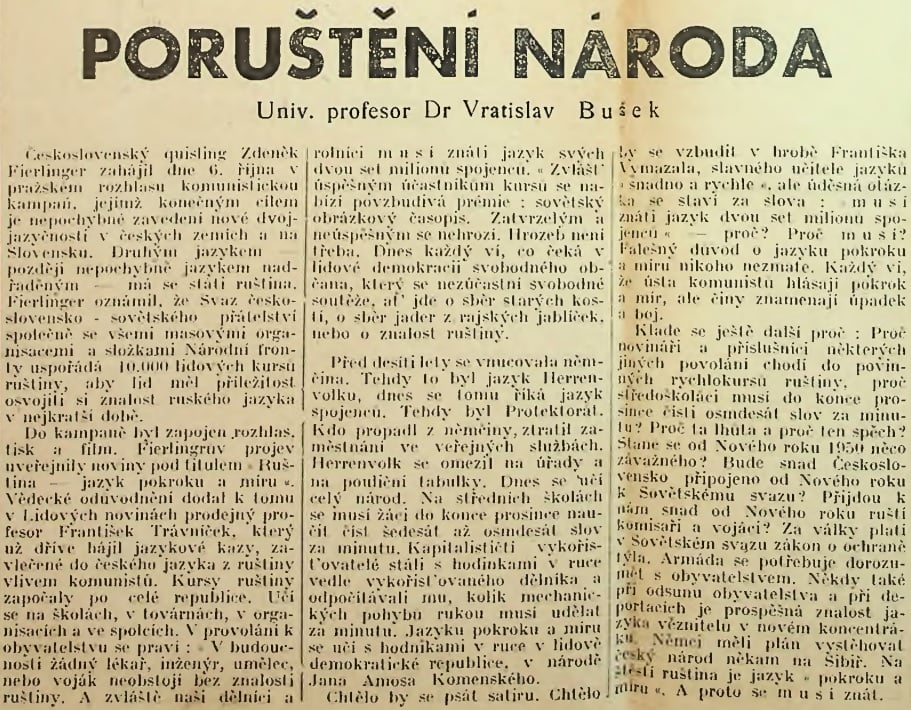
Ruština – jazyk pokroku a míru (1949)

Filed under: Eseje, fejetony, přednášky — Přemek @ 11:33

Zdeněk Fierlinger. Přednáška.

Natočeno 1949. Premiéra 6. 10. 1949 (Praha I, 6:55 – 7:00 h.) v cyklu Jazykový koutek.

Lit.: Bušek, Vratislav: Poruštění národa. In Svobodný zítřek: List demokratických Čechoslováků v exilu 12/1949 (3. 11. 1949), s. 1 (článek).

Host Radiožurnálu – Ester Ledecká (2026)

Filed under: Radiodokument — Přemek @ 11:01

Hostem je Ester Ledecká. Na olympiádě před osmi lety předvedla nevídané a vyhrála zlatou medaili na lyžích i na snowboardu. O čtyři roky později přidala další medaili. A i letos hrdě reprezentovala Česko na hrách v Itáliii. Jak se žije s očekáváním, že pokaždé přijde něco výjimečného? A v čem se chce ještě zlepšovat? Moderuje Libor Bouček.

Natočeno 2026. Premiéra 18. 5. 2026 (ČRo 1 Radiožurnál, 9:06 h.). Repríza 6. 8. 2026 (ČRo 1 Radiožurnál, 9:06 h.).

Interview Plus – Timothy Snyder (2026)

Filed under: Radiodokument — Přemek @ 11:01

Timothy Snyder, historik, znalec dějin střední a východní Evropy, intelektuál, který se otevřeně a kriticky vyjadřuje i k aktuální politické situaci stávající americké administrativy. Jak hodnotí Trumpovu návštěvu v Číně, a proč o něm říká, že má negativní charisma? A jaký je v jeho pojetí rozdíl mezi historií a minulostí? Na Světě knihy s ním debatoval Petr Vizina.

Natočeno 2026. Premiéra 18. 5. 2026 (ČRo Plus, 11:34 h.; 21 min.).

Lit.: Vizina, Petr – ert (= Erhart, Michael): Snyder: Trumpovou podstatou je prohrávat a předstírat, že je to výhra. V zájmu republikánů je drtivě prohrát volby. In web ČRo Plus, 18. 5. 2026 (článek + nahrávka k poslechu). – Cit.: Donald Trump prezentuje své druhé prezidentské období jako sérii úspěchů a vítězství. Zda tomu věří i samotní Američané se ale ukáže v listopadových volbách – americký historik Timothy Snyder mu v nich předpovídá jasnou porážku. „Prohrávat a předstírat, že je to výhra, v tom tkví podstata Donalda Trumpa. Republikáni právě prohrávají na celé čáře a jedno je jisté. On sám odpovědnost nepřijme, protože za nic v životě nikdy odpovědnost nepřijal,“ říká v Interview Plus.

V kontextu nedávné cesty do Číny vyčítá Trumpovi, že připravil Spojené státy o část jejich vlivu a nechal se Říší středu dohnat, k čemuž by nikdy nedošlo, pokud by se nestal prezidentem. Vyčítá mu zaostávání ve vědě a školství či obrovskou porážku ve válce s Íránem.

Válku na Ukrajině nejenže nedokázal ukončit, ale ještě se v ní staví na stranu Ruska, kterému vštěpuje falešnou sebedůvěru, že zvítězí, zdůrazňuje Snyder. A stejně tak v případě Tchaj-wanu není v jeho moci přenechat ho Číně, svým chováním ale vytváří situaci, v níž by Číňané mohli udělat nějakou hloupost.

„Myslím, že to je dobrý způsob, jak Trumpa popsat. Vytváří kolem sebe pole pravděpodobnosti, v němž je větší šance, že lidé udělají něco hloupého. Ale neznamená to, že tím dosáhnou toho, co chtějí,“ konstatuje znalec dějin střední a východní Evropy, který byl hostem Interview Plus na veletrhu Svět knihy. (…)

Osobnost Plus – Jan Dobrovský (2026)

Filed under: Radiodokument — Přemek @ 10:59

Jan Dobrovský, filantrop, podnikatel, publicista. „Něco takového jsem opravdu nezažil. V tom, jak je to primitivní a jak je ta arogance pohrdavá,“ říká o vládě Andreje Babiše. Podle jakých pravidel se dnes řídí česká politika? A sdílí obavy předsedy Ústavního soudu Josefa Baxy, který varuje před projevy autoritářství a současnou atmosféru ve společnosti přirovnává k době před nástupem nacismu. Ptá se Barbora Tachecí.

Natočeno 2026. Premiéra 18. 5. 2026 (ČRo Plus, 10:34 h.).

Lit.: Tachecí, Barbora – jud: Arogance a totální stupidita. Politika se stává více hnojištěm než elitní sestavou, míní Dobrovský. In web ČRo Plus, 18. 5. 2026 (článek + nahrávka k poslechu). – Cit.: Předseda Ústavního soudu Josef Baxa přirovnal společenskou atmosféru k době před nástupem nacismu. Ve světě obav, strachů a válek se proměňuje i komunikace některých politiků a slušnost je vnímána jako slabost. „Zájem o politiku klesá, neboť se politika stává víc takovým hnojištěm než nějakou elitní skupinou,“ poukazuje v pořadu Osobnost Plus Jan Dobrovský, podnikatel, filantrop a neoficiální poradce prezidenta. (..)

„Předseda Ústavního soudu vidí, že vláda je složená z extremistů a premiér, který extremisty podporuje tím, že je nekárá nebo jim extremistické projevy nezakáže, se sám stává extrémistou,“ hodnotí podnikatel Baxův projev, který zazněl na pietním aktu v Terezíně.

Dnešní doba sociálních sítí podle Dobrovského usnadňuje propagandu více než kdykoli předtím. Současná vláda prý bezpečnost země ohrožuje i tím, že ve společnosti vyvolává staré nenávisti, například tématem sudetských Němců.

„Tato vláda, kterou považuji za naprosto nejodpornější, jakou tato republika od svého vzniku v roce 1989 měla, se chová tak, že ohrožuje bezpečnost země. A to nejen tím, že podceňuje její obranu, ale vyvolává staré vášně ze sovětské komunistické propagandy,“ poukazuje podnikatel ve vysílání Českého rozhlasu Plus. (…)

Blízká setkání – Karolína Fourová (2026)

Filed under: Radiodokument — Přemek @ 10:59

Host: Karolína Fourová, výživová poradkyně, autorka knih o výživě. Jaké největší výživové mýty dnes mezi lidmi stále přetrvávají? Jaká je podle ní nejlepší změna, kterou můžeme udělat pro lepší zdraví a energii? Jak si udržet zdravý vztah k jídlu bez stresu, zákazů a neustálých diet? Moderuje Marek Němec.

Natočeno 2026. Premiéra 18. 5. 2026 (ČRo 2 Praha, 11:04 h.).

Pro a proti – Summit NATO: Babiš či Pavel? (2026)

Filed under: Radiodokument — Přemek @ 10:57

Babiš či Pavel? Který z nich by lépe hájil zájmy Česka na summitu v Ankaře? Měli by se na tom dohodnout politici, nebo je na místě, aby rozhodl Ústavní soud? Má přednost článek 63 Ústavy, podle kterého prezident zastupuje stát navenek, nebo kompetenční zákon, podle kterého určuje zahraniční politiku vláda? Debatovat budou poradce ministra zahraničí, ředitel Institutu Václava Klause a jeho bývalý kancléř na Hradě Jiří Weigl, a poradce současného prezidenta a bývalý velvyslanec například ve Spojených státech a někdejší politik Michael Žantovský. Moderuje Lukáš Matoška.

Natočeno 2026. Premiéra 18. 5. 2026 (ČRo Plus, 9:34 h.).

Lit.: Matoška, Lukáš – vvr: Babiš, nebo Pavel? Žantovský: Na summitu je víc než jedna židle. Weigl: Nevím, proč tam Pavel chce. In web ČRo Plus, 18. 5. 2026 (článek + nahrávka k poslechu). – Cit.: Má Česko na summitu NATO zastupovat prezident, nebo premiér? Podle poradce ministra zahraničí a ředitele Institutu Václava Klause Jiřího Weigla by se na složení delegace měli politici dohodnout a netahat spor na veřejnost. „Nerozumím tomu, proč Petr Pavel bojuje o to, aby mohl obhajovat názory, se kterými nesouhlasí, a podávat si ruce s lidmi, které nemá rád,“ dodává. „Vláda popírá ústavní zvyklosti, které tady 25 let fungují,“ namítá poradce prezidenta Michael Žantovský. (…)

Osudy – Petr Vronský 1/5 (2026)

Filed under: Radiodokument — Přemek @ 10:26

Rozhlasové vzpomínání houslisty a všestranného dirigenta na život na operních scénách a symfonických pódiích. Připravila Eva Ocisková. Technická spolupráce Jan Brauner.

Natočeno 2026. Premiéra 18. – 22. 5. 2026 (ČRo 3 Vltava, 11:30 h.).

« Newer Posts — Older Posts »

Powered by WordPress