Panáček v říši mluveného slova stránky přátel rozhlasových her a mluveného slova vůbec

4. 10. 2018

Kirjakandja muinasjutt (Pošťácká pohádka, 1956)

Filed under: Cizojazyčné,Rozhlasové hry — Premek @ 22:34

Karel Čapek. Dramatizace pohádky z knihy Devatero pohádek. Hudba Toomas Rood. Režie Enn Toona.

Osoby a obsazení: pošťák Kolbaba (Ilmar Tammur), šofér Frantík (Ervin Abel), jeho Mařenka (Asta Lott), poštovní skřítkové (Kaljo Kiisk, Jüri Järvet, Helmut Vaag), host (Johannes Rebane), vypravěč (Arvo Kruusement).

Natočeno 1956 (29 min). K poslechu zde.

Alternativní verze názvu: Muinasjutt kirjakandjast

Hingamine (Dýchání, 1991)

Filed under: Cizojazyčné,Rozhlasové hry — Premek @ 22:27

Jiří Klobouk. Smutný monolog muže, který v touze po kontaktu marně vytáčí různá telefonní čísla a slyší většinou jen záznamník a ozvěnu vlastního dechu.

Účinkují Kaljo Kiisa, Malle Pärn, Hille Simm, Carmen Mikiver, Anne Eenpalu, Ülo Lodeson, Riho Västrik, Mart Puust, Härmo Saarm.

Natočeno 1991. Premiéra 7. 10. 1991 (Estonský rozhlas, 15:05 h) v cyklu Klassikaraadios.

Spačilova juhtum 1/5 (Případ Spáčilová, 1967)

Filed under: Cizojazyčné,Rozhlasové hry — Premek @ 13:44

Ondřej Vogeltanz a Leoš Jirsák. Rozhlasová detektivní hra. Překlad Veronika Kruus. Režie Leo Martin. Hudba Jaan Koha. Zvukový mistr Aino Lauri. Záznam a střih Urve Marka.

Osoby a obsazení: Hana Spáčilová (Aino Talvi), Spáčil (Valdeko Ratassep), Kubeš (Helmut Vaag), Jiráčková (Ellu Puudist), Hanka (Astrid Relve), průvodčí (Endel Simmermann), Stárek (Gunnar Kilgas), Pavelec (Kaarel Toom), zákazník (Laine Vaga), Velíšek (Rudolf Nuude). Dále účinkují Ain Jürisson, Leo Martin, Roland Engman, Hanno Kalmet, Ly Mander, Laine Vaga, Erna Korjus, Hans Kaldoja, Ivi Aalak, Robert Gutman, Lembit Veri, Tanel Lään, Aksel Lemberg, Maret Karindi.

Natočeno únor 1967. Premiéra 10. – 14. 4.1967 (Estonský rozhlas, 1 díl cca 10 min.). K poslechu zde.

Česká inscenace Věc důvěry

2. 10. 2018

Popas króla Jegomości (1966)

Filed under: Cizojazyčné,Rozhlasové hry — Premek @ 22:57

Adam Grzymała-Siedlecki. Rozhlasová úprava komedie z roku 1922. Rozhlasová úprava Klemens Białek. Režie Zdzisław Nardelli. Zvuková mistryně  Stanisława Grotowska. Hudba Augustyn Bloch.

Osoby a obsazení:  Miecznik Kręgosławski (Kazimierz Wichniarz),  Małgorzata (Barbara Krafftówna), král Jindřich Waleský (Czesław Wołłejko),  Pieter (Wojciech Siemion),  Podczaszy Kalasanty Jażwicki (Zdzisław Mrożewski),  Kaśka (Joanna Walterówna), Desportes (Tadeusz Surowa),  Kanonik (Ignacy Machowski), Starościna (Wanda Łuczycka),  Kajetan (Czesław Mroczek).

Natočeno 1966. Premiéra 22. 5. 1966.

Anna Karenina (Anna Kareninová, 2018)

Filed under: Cizojazyčné,Rozhlasové hry — Premek @ 22:29

Lev Nikolajevič Tolstoj. Překlad Kazimiera Iłłakowiczówna. Rozhlasová dramatizace Magdalena Wleklik. Režie  Katarzyna Michałkiewicz. Zvukový mistr Maciej Kubera. Hudba Aleksander Dębicz.

Osoby a obsazení: Anna Karenina (Wiktoria Gorodeckaja), Alexej Vronský (Aleksy Wroński), Karenin (Bartosz Opania). Dále účinkují  Krzysztof Banaszyk,  Karol Kwiatkowski, Julia Kołakowska – Bytner,  Paulina Komenda, Marta Dylewska,  Antoni Paradowski,  Kamil Przystał, Wojciech Chorąży a Iwo Jedynecki.

Natočeno 2018. Premiéra 30. 9. 2018 (Polskie Radio Jedynka, 21:00 h).

Lit.: anonym: Lew Tołstoj „Anna Karenina“. In web Polskieradio.pl, 27. 9. 2018 (článek). – Cit.: 30 września o godzinie 21:00 zapraszamy do wysłuchania słuchowiska „Anna Karenina“ Lwa Tołstoja w adaptaci Magdaleny Wleklik i reżyserii Katarzyny Michałkiewicz.

„Współcześnie, podobnie jak w każdych innych czasach, zdarzają się trójkąty miłosne. Rozwiązanie ich ma zwykle dramatyczny przebieg, pozostawiając na swej drodze ofiary. Historia Anny Kareniny nie różni się w tej mierze i właśnie przez swą uniwersalność sprawia, że do niej wracamy w każdym pokoleniu. Postać Anny została uwspółcześniona w warstwie psychologicznej, a jej miłosne rozterki są egoistyczne i niedojrzałe. Ta koncepcja jest przełomowa. Choć nie zostało zmienione żadne słowo z powieści Lwa Tołstoja, historia stała się nieszablonowa – może wydać się anty-miłosna, opowiadać o braku szacunku, zazdrości, zagubieniu… Anna w słuchowisku staje się postacią charyzmatyczną, a nie płytką i zepsutą jak w dotychczasowych adaptacjach. Została uwspółcześniona, nie wyidealizowana. Sam proces radiowej adaptacji literatury niesie ze sobą ryzyko, jak nie rozminąć się z wizją autora, jak zamknąć 900-stronicowe tłumaczenie Kazimiery Iłłakowiczówny w godzinnym słuchowisku… To są techniczne trudności, gdyż sam proces adaptacji nie był trudny, właśnie ze względu na emocje Anny, które są uniwersalne. Łatwo wyobrazić sobie wybór, przed jakim Anna stoi. Trudno samemu podjąć decyzję. Sama tragedia Anny wykracza poza nią samą, poza miłosny trójkąt, dotyka wszystkich ludzi dookoła“ – Magdalena Wleklik o adaptacji (…).

25. 9. 2018

Catch My Breath 1/5 (Popadnout dech, 2007)

Filed under: Cizojazyčné,Seriály — Premek @ 10:43

Marty Ross. Hrůzostrašný příběh. Produkce Bruce Young.

Osoby a obsazení: Kate (Claire Knight), Colleen (Suzanne Donaldson), Strachan (Liam Brennan), Old Strachan (John Shedden), Donnie (Lewis Howden), Isla (Eileen McCallum), Octavia (Lucy Patterson), DC Carbeth (James Bryce), WPC Briggs (Jill Riddiford), Dennis (Finlay McLean).

Nastudoval BBC 7 – BBC Radio Scotland v roce 2007. Premiéra 2. dílu 11. 12. 2007 (BBC Radio 7, 18:00 h).

Lit.: anonym: Marty Ross – Catch My Breath. Episode 1. In web BBC Radio 4 Extra, září 2018 (anotace). – Cit.:  On the run from a women’s prison in the Scottish Highlands, Kate and Colleen are given refuge in a vast country mansion by a charming but rather enigmatic host, Adam Strachan. It could be a decision they come to regret… The storyline for Marty Ross’s supernatural five-part thriller is based around the notion, found in old Scottish folk tales, of the Beatha Greimach – literally ‚The Breath Thief‘ – a celtic demon said to lure victims into a kiss which would drain the soul from their bodies.


24. 9. 2018

Dragonwyck (1946)

Filed under: Cizojazyčné,Rozhlasové hry — Premek @ 15:57

Anya Seton. Dramatizace románu.

Účinkují Vincent Price, Gine Tierney a další.

Natočeno 1946. Premiéra 7. 10. 1946 (The Lux Radio Theater, 53 min.).

Pozn.: Rozhlasová adaptace založená na filmovém scénáři.

Lit.: anonym: Dragonwyck (1946) | Time to bow down to Vincent Price’s Hudson Valley Bluebeard. In web The Sound of Vincent Price, 10. 4. 2017 (článek + nahrávka k poslechu). – Cit.: On a gloomy estate in New York’s Hudson Valley in 1844, feudal Dutchman Nicholas Van Ryn (Vincent Price), cruelly lords it over his tenants. Married to Johanna (Vivienne Osborne), whom he resents because she has been unable to bear him a son, he secretly kills her when he sees a prize in Miranda Wells (Gene Tierney), the new governess of his daughter Katrine (Connie Mar). But when Miranda accepts Nicolas’ proposal of marriage, she is unaware she is about to enter her own domestic nightmare…

Vincent Price’s career as the Merchant of Menace really began to take off in 1946, in both this Rebecca meets Jane Eyre Gothic melodrama, and in Shock, in which he played a mad doctor. An engrossing early exhibition of Price’s unique brand of creeping insanity (and the first of his ‘dead wives’ horrors), this elegant chiller was one of the actor’s favourites amongst his own performances on the big screen. Gene Tierney is bewitching as endangered spouse Miranda, while Jessica Tandy plays a crippled Irish maid (‘Deformed bodies depress me!’ says Price’s Van Ryn); and Glenn Langan is the local nice guy who becomes Miranda’s knight in shining armour.

Along with Roger Corman’s House of Usher, Dragonwyck was a huge influence on Guillermo del Toro’s Crimson Peak, with Tom Hiddleston’s mysterious English baronet Sir Thomas Sharpe being modelled on Price – whose his climactic speech as Van Ryn still sends shivers down the spine.

Directed by Oscar-winner Joseph Leo Mankiewicz and based on Anya Seton’s 1944 novel, Dragonwyck opened in US cinemas on 10 April 1946 and was later adapted for radio, featuring both Price and Tierney reprising their roles, which went out on 7 October 1946 on the Lux Radio Theater. You can listen to it in full here.

‘Vincent Price gives a picturesque performance as the regal and godless patroon, using his face and his carriage to demonstrate insolence, that’s all. Clean shaven and elegantly tailored, he still makes a formidable Bluebeard, and his moments of suave diabolism are about the best in the film. Gene Tierney is fairly ornamental in the role of the tortured child bride, but she plainly creates no more character than the meager script provides. Of the several lesser characters, Walter Huston is most credible as the forthright, God-fearing father of the cardboard heroine.’ Bosley Crowther, New York Times

The Price of Fear 1/22 (Cena strachu, 1973-1983)

Filed under: Cizojazyčné,Seriály — Premek @ 15:36

Cyklus dramatizací hrůzostrašných příběhů. Roald Dahl (1), William Ingram (2, 4, 7, 8, 12, 15 – 21), Stanley Ellin (3), Robert Arthur (4), Richard Davies / Davis (5, 13), R. Chetwynd-Hayes (6), Barry Campbell (9), A. M. Burrage (9), Elizabeth Morgan (10), Rene Basilico (11), Bram Stoker (13), Maurice Travers (14), Charles Birkin (14), Jack Ritchie (15). Režie John Dyas.

Účinkují Vincent Price, Edward Woodward, Annette Crosby, Margaret Courtney, Sheila Grant, Henry Stamper, Shandor Ellis, Mervyn Johns, Michael Gwynne, Clive Swift, Avril Angers, Diana Bishop, Robin Brown, Gerhard Greene, Phyllis Schroeder, Kenneth J. Warren, Frederick Schraeker, John Sampson, Bonnie Harron, Kate Coleridge, Steve Plietus, Michael Deacon, Peter Cushing, Diana Olson, Steve Preston, Elizabeth Morgan, Douglas Blackwell, Alexander John, Peter Barkweth, Cyril Schaps, Joan Cooper, Christopher Bidmeade, Bruce Beebe, Amanda Marley, Bill Kerr, Coral Brown, John Grahame, Roger Snowdon, Michael Burlington, Morris Perry, Maurice Denham, Betty Humphrey-Wright, Peter Williams, Hugh Burton, Frances DeWolff, Vernon Joiner, William Slade, Freda Jackson, Richard Pearson, Claire Sutcliffe, Michael Siegel, Alan Rowe, Freddie Jones, Geoffrey Collins, Anne Jamieson, Michael Jayston, Daphne Heard , Sondra Clarke, Nigel Grahame.

Natočeno 1973 – 1983 (BBC World Service; BBC Radio 4; BBC 7).

Obsah: 1. William and Mary by Barry Campbell (based on the story by Roald Dahl). Premiéra 9. 4. 1973 – 2. Come As You Are by William Ingram. Premiéra 2. 7. 1973 – 3. Speciality of the House /Specialita šéfkuchaře/ (based on the story by Stanley Ellin). Premiéra 3. 7. 1973 – 4. The Man Who Hated Scenes by William Ingram (based on the story by Robert Arthur). Premiéra 29. 9. 1973 – 5. Guy Fawkes‘ Night by Richard Davies. Premiéra 17. 11. 1973 – 6. The Ninth Removal (based on the story by R. Chetwynd-Hayes). Premiéra 19. 11. 1973 – 7. Soul Music by William Ingram. Premiéra 1. 7. 1973 – 8. An Eye for An Eye by William Ingram. Premiéra 4. 7. 1975 – 9. The Waxwork by Barry Campbell (based on the story by A.M Burrage). Premiéra 18. 7. 1973 – 10. Lot 132 by Elizabeth Morgan. Premiéra 25. 7. 1973 – 11. Fish by Rene Basilico. Premiéra 8. 8. 1973 – 12. Blind Man’s Bluff by William Ingram. Premiéra 4. 8. 1975 – 13. Cat’s Cradle by Richard Davis (based on „The Squaw'“ by Bram Stoker). Premiéra 15. 9. 1973 – 14. Meeting in Athens by Maurice Travers (based on „So Cold, So Pale, So Fair“ by Charles Birkin). Premiéra 22. 9. 1973. – 15. Remains to be Seen by William Ingram (based on the story by Jack Ritchie). Premiéra 1. 9. 1973 – 16. The Family Album by William Ingram. Premiéra 8. 2. 1983. – 17. Not Wanted on Voyage by William Ingram. Premiéra 26. 4. 1983 – 18.  Goody Two Shoes by William Ingram. Premiéra 27. 4. 1983. – 19.To My Dear, Dear Saladin by William Ingram. Premiéra 27. 4. 1983. – 20. Out of the Mouths by William Ingram. Premiéra 11. 5. 1983. – 21. Is There Anybody There? by William Ingram. Premiéra 25. 5. 1983. – 22. Never Gamble With A Loser. Premiéra ??.

Lit.: anonym: The Price of Fear Radio Program. Background. In web The Digital Deli Too, b. d. (článek). – Cit.:  The Price of Fear will always be associated more with Vincent Price the famous American actor and host of the series, than its British Broadcasting Corporation (BBC) production history. BBC’s World Service first broadcast the intial order of five The Price of Fear episodes in the Spring of 1973. The initial five episodes aired consecutively, Monday through Friday between July 2, 1973 and July 6, 1973, then again between December 17 and December 21 of the same year. The World Service broadcasts were so popular that the BBC ordered another five, which, combined with the previous five episodes, apparently aired weekly on both Tuesdays and Saturdays, from September 1, 1973 to November 6, 1973.

By 1974, the BBC’s Radio 4 had ordered another six installments of the series, now widely referred to as Season 2, which aired weekly from April 6, 1974 through May 11, 1974. Remember that the BBC, a state-owned broadcasting service traditionally prohibited any form of commercial messages or sponsorship. Any series that was extended or expanded was due only to listener support, letters and phone calls to the service. The series‘ that returned again and again over the BBC had only their listeners to thank for their longevity.

The BBC’s Radio 4 ordered another six installments in 1982, for a Season 3, which aired weekly from May 30, 1983 through July 4, 1983, bringing the entire canon to a theoretical twenty-two installments over ten years and three ostensible ‚seasons.‘ We say ostensible, since the intent and actual air dates and order for the 1973 broadcasts are still somewhat ambiguous.
The Price of Fear becomes a popular international favorite

Recorded in every corner of the world when first broadcast over the BBC’s World Service, The Price of Fear soon became one of the most widely recorded offerings of its era. As with most BBC productions, the acting talent and production values were excellent throughout. The stories dramatized in the series are from some of the supernatural fiction world’s finest authors. William Ingram was responsible for almost half of the stories and scripts, backed up the works of Bram Stoker, Roald Dahl, Robert Arthur, Rene Basilico, Stanley Ellin, and R. Chetwynd-Hayes. John Dyas produced and directed all three series over the ten year period.

Host Vincent Price, already long since recognized throughout the world as the reigning Master of The Macabre, virtually ensured that the series would be heard. True to his legend, Price’s imprimatur on the series provided a voice as chilling and familiar to World Service listeners as that of their own Christopher Lee and Peter Cushing. The Price of Fear has been an international favorite ever since it’s first airing. It was picked up by several short-wave and FM stations in the U.S. and enjoyed broadcast airing over several American public broadcasting stations from 1973, on. The BBC’s proscription against commercial broadcast of its productions left only national or public broadcasting networks and stations capable of airing the compelling program. (more…)
Penseln, pennan och hjärtat 1/8 (Kartáč, pero a srdce, 2017)

Filed under: Cizojazyčné,Podcast — Premek @ 9:28

Dokumentární podcastový cyklus o tvůrkyni příběhů o mumincích, Tove Janssonové.

Natočeno 2017. Zveřejněno 5. 4. 2017 (podcast Acast).

Obsah:  1. Barnet Tove: äventyret, tryggheten och katastrofen – 2. Ett konstnärsfrö växer – 3. Mumin och kriget – 4. Passion på teaterscenen – 5. Berömmelsen som blev en boja – 6. Tove och havet – 7. Frihet framför allt – 8. Arvet efter Tove.

Lit.: anonym: Penseln, pennan och hjärtat – en dokumentär om Tove Jansson. In web Acast.com, b. d. /5. 4. 2017/ (článek + nahrávky k poslechu). – Cit.: Vem var Tove Jansson bakom den mediala bilden av en vänlig barnboksförfattare med mjuk page och lika mjuk röst? – Ibland beskrivs hon som en sån där sockersöt muminmamma.

– Nå det var hon ju ingalunda, konstaterar Sophia Jansson, Tove Janssons brorsdotter. Fortfarande så är det ju så att hon är mest känd som skaparen till muminböckerna och väldigt få vet om att hon skrev något annat alls, för att inte tala om att de inte vet att hon målade tavlor, gjorde en massa brukskonst, skrev romaner och noveller, fortsätter hon.Brorsdottern är en av de som ger sin syn på multikonstnären Tove Jansson i dokumentärserien Penseln, pennan och hjärtat, där lyssnaren får följa med Toves levnadsbana och de miljöer, människor och livsval som påverkade henne i åtta fristående avsnitt.Tove Jansson föddes i ett Finland som var en autonom del av det ryska kejsardömet, och hennes liv är på många sätt sammankopplat med den finska nationens historia. Varför blev till exempel det finska inbördeskriget en sådan nyckelhändelse för…

21. 9. 2018

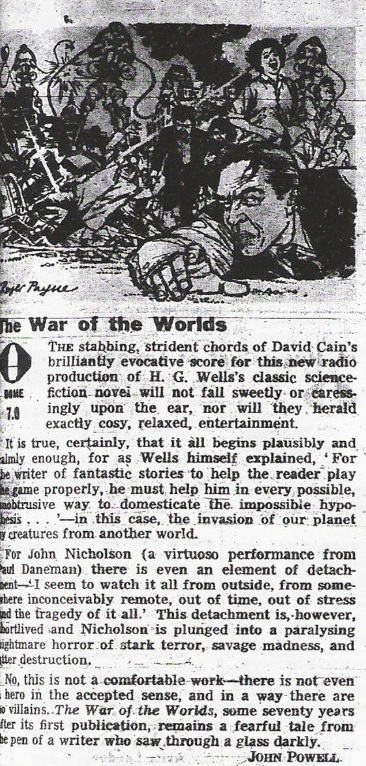
War of the Worlds 1/6 (Válka světů, 1967)

Filed under: Cizojazyčné,Seriály — Premek @ 14:55

Herbert George Wells. Dramatizace Jon Manchip White. Zvuk David Cain (BBC Radiophonic Workshop). Produkce John Powell.

Osoby a obsazení: profesor John Nicholson (Paul Daneman),  Ogilvy, jeho asistent (Martin Jarvis), Dora Nicholson (Isabel Rennie),  Sir James Stent (Harold Kasket), seržant Holroyd (Alan Dudley), poručík (Anthony Jackson), plukovník (Ronald Herdman), desátník (Frank Henderson), starý gentleman (Walter Fitzgerald), farář (Peter Sallis), mluvčí (Denys Hawthorne, Anthony Hall). Dále účinkují  Brian Hewlett, LeRoy Lingwood, Christopher Bidmead, Ronald Herdman, Ian Thompson, Alan Dudley, Carole Boyd, Rolf Lefebvre a Beth Boyd.

Natočeno 1967. Premiéra 9. 6. 1967 (BBC, 19:00 – 19:30 h) –

Obsah: 1. The Red Planet. June 9, 7pm to 7.30pm.
2. The Heat Ray. June 16, 7pm to 7.30pm
3. The Fighting Machines. June 23, 7pm to 7.30pm
4. The Black Smoke. June 30, 7pm to 7.30pm
5. The Red Weed. July 7, 7pm to 7.30pm
6. The Bacillus. July 14, 7pm to 7.30pm

Lit.: anonym: War of the Worlds radio broadcast (BBC, 1950 and 1967). In web War of the Worlds, b.d. (článek). – Cit.:

warofworldsWhat a shame then that this extraordinary sounding production may no longer exist, but we can hope for a flavour of it since the 1967 version has survived and seems to share a connection, because Jon Manchip White is again listed as the writer. Yet there is a mystery here, since as he himself has told me in no uncertain terms, „I could not have been concerned with it because 1967 was the year in which I first came to America to take up a professorship at the University Of Texas.“ The 1967 version certainly can’t be a direct word for word remake, since it is thoroughly updated, with a modern English setting, helicopters and jet fighters, yet White has the sole writing credit, the episode titles are identical and both productions share very similar character names. Despite all this, it remains to be seen how much of White’s original dialogue survives into the 1967 version.

The first episode introduces us to the character of Nicholson, played by Paul Daneman. Nicholson replaces Wells‘ nameless narrator, though in a fairly major departure from the original novel the character is now an astronomer and Ogilvy his assistant. Nicholson is a determined believer in the possibility of life on Mars, and sees the eruptions he is observing on Mars as proof positive of an impending invasion. This is fully confirmed by the arrival of the first cylinder and the emergence of a Martian. In the second episode troops and helicopters arrive to contain the Martians, with one of the pilots assuming the role of the Artillery man, but despite his best efforts to dissuade them from the attempt, Nicholson is unable to stop Ogilvy and the Astronomer Royal Stent from leading a peace delegation to their doom at the hands of the Heat Ray.

By the third episode a second Cylinder is seen to arrive and Nicholson’s predictions are proven horribly true when the badly injured helicopter pilot stumbles into his home with news of a terrible defeat for the army and air force. There are some effective descriptions of modern weapons succumbing to the Heat Ray, such as the rotors disintegrating on a helicopter and interesting speculation on the problem with fighting the Martians with modern weapons in the midst of a civilian population. The episode culminates with a fantastic re-imagining of the battle for Shepperton with tanks against the Martian Tripods.

In the 4th episode there is another fantastically realised battle, this time with Jet Fighters against the Tripods, but most are shot down and the Martians deploy their Black Smoke against waiting Tanks. By now, Nicholson has met the Priest and the pair become entombed beneath a newly arrived Martian cylinder. Peter Sallis (British readers will likely recognise him for his long running portrayal of the wonderfully reprehensible Norman Clegg in Last of the Summer Wine) plays the conflicted priest to perfection.

For the penultimate episode, Nicholson arrives in London (the character of his brother is entirely excised from this version) and meets the helicopter pilot again, who seems to have landed on his feet and is plotting the survival of the human race by retreating underground, though first he persuades Nicholson to set up base in an abandoned luxury hotel. The highlight of this episode has to be a superb recap of the Martian assault, replayed from the point of view of government pronouncements, at first incredulous in tone, then humorous and smugly confident, before becoming increasingly panicked and strident. In another interesting departure from the novel, Nicholson is far more receptive to the ideas of his companion, and there is an interesting reference to the visibility of the Canals on Mars. I feel this may be one definite example of original dialogue from the 1950 production, as by 1967, the idea of Canals on Mars had been refuted, not least by the return of photographs a few years previously by Mariner 4.

The final episode builds to a highly satisfying crescendo, with the Martians defeated as in the original novel by Earthly germs, but ends a little differently, bringing Nicholson and the helicopter pilot together one more time for an ominous discussion about the chances of another invasion.

The sound and music for the 1967 version is provided by the BBC Radiophonic Workshop, which I have never found to be a particularly entertaining listening experience, with its trademark cacophony of discordant notes, but this is the only real (and subjectively personal) criticism I can level at the production, which boasts excellent acting and a well thought out script, though not uncommonly to adaptations, the portion of the book containing the adventures of the narrators brother is completely removed,. This means rather tragically that the sequence involving the Thunderchild is absent.

The episodes titles and broadcast times are as follows. (Click on the links to see the original BBC Radio Times entry for each).


« Newer Posts — Older Posts »

Powered by WordPress